
Published: November 2, 2026 | 8 Min Read
How Can Schools Protect CCTV and Communication Systems from Lightning-Induced Surges During the Rainy Season?
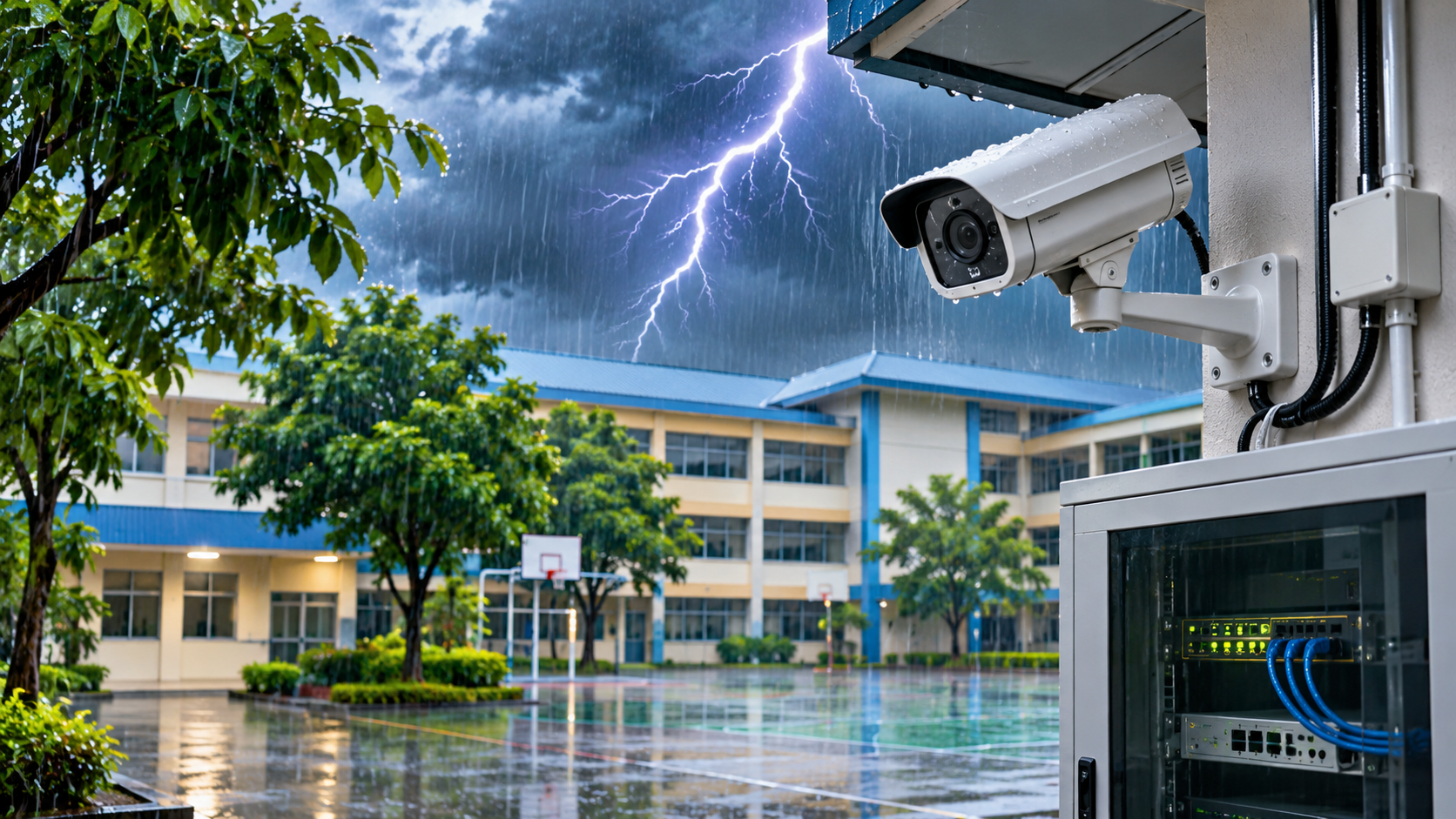
During the rainy season, thunderstorms and lightning can create electrical risks for buildings and connected electronic equipment. Schools that use CCTV cameras and communication systems across their campuses should consider how these systems are connected to the building’s electrical infrastructure.
A lightning-related surge does not necessarily require a direct strike on a CCTV camera to affect connected equipment. Electrical and communication connections can provide pathways through which transient overvoltages may reach sensitive devices.
For school management and facility teams, the important question is not simply how to protect individual cameras, but how to assess the complete connected system.
1. Why Are School CCTV and Communication Systems Vulnerable to Electrical Surges?
School campuses may have CCTV cameras and connected equipment installed across different buildings and locations. These installations can involve power connections, communication cables, recording equipment, and network devices.
During lightning events, connected electrical and communication systems may be exposed to transient overvoltages.
Some areas that should be considered include:
- CCTV cameras installed in outdoor locations.
- Recording equipment connected to camera systems.
- Network switches and associated equipment.
- Power connections supplying surveillance equipment.
- Communication cables connecting different parts of the campus.
The level of exposure depends on the installation, cable routes, electrical connections, and existing protection arrangements.
2. Which School Systems Should Be Included in a Surge Protection Assessment?
Protecting only the camera may not address every possible pathway into a connected CCTV system. Schools should consider the complete installation before deciding on protection requirements.
| School System | What Should Be Assessed? |
|---|---|
| Outdoor CCTV cameras | Location, power supply and connected cables. |
| CCTV recording equipment | Electrical connections and connected communication pathways. |
| Network equipment | Connected circuits and equipment compatibility. |
| Communication systems | Cable routes and electrical connections. |
| Campus electrical panels | Existing surge protection arrangements. |
This assessment helps identify which parts of the installation may need attention.
3. How Can Schools Reduce Lightning-Related Surge Risks?
A suitable protection strategy should consider the building’s electrical infrastructure and the connected electronic equipment.
A. Identify All Connected Equipment
Prepare an inventory of CCTV cameras, recording equipment, network devices, and communication systems.
Check how each device is connected and identify equipment installed in different buildings or outdoor locations.
B. Review Power and Communication Pathways
CCTV and communication installations may have multiple electrical connections.
School facility teams should identify:
- Where power connections enter the equipment.
- How communication cables connect different devices.
- Where cables enter buildings or equipment areas.
- Whether equipment is connected across separate buildings.
These details help engineers understand the installation before selecting suitable protection.
C. Consider Appropriate Surge Protective Devices
Surge Protective Devices (SPDs) are designed to limit transient overvoltages and divert surge currents as part of an electrical protection arrangement.
The selection of an SPD should consider the circuit being protected, connected equipment, and installation requirements.
LES Ecotonik Systems provides surge protective devices for electrical protection applications. Schools and project teams can explore the Surge Protective Devices range to understand the available product categories.
D. Review Earthing and Bonding
Surge protection should not be considered separately from the building’s earthing and bonding arrangements.
An appropriate protection strategy should review:
- The existing earthing arrangement.
- Relevant bonding connections.
- The grounding requirements of selected SPDs.
- The relationship between surge protection and the wider lightning protection system.
LES also provides Earthing and Bonding solutions, which form part of its electrical protection portfolio.
4. Why Is External Lightning Protection Alone Not Enough?
External lightning protection and surge protection serve different functions.
| Protection Component | Role in the Protection System |
|---|---|
| External lightning protection | Forms part of the system designed to manage lightning strikes to a structure. |
| Surge protection | Helps limit transient overvoltages in electrical installations. |
| Earthing and grounding | Forms part of the electrical protection arrangement. |
| Bonding | Connects relevant conductive parts as part of the protection design. |
Installing an external lightning protection system does not automatically mean that every connected electronic device is protected against transient overvoltages.
For schools with CCTV and communication equipment, the protection strategy should consider both the building and its connected electrical and electronic systems.
5. What Should School Management Check Before the Rainy Season?
Before the rainy season, school management and facility teams can review the following areas with qualified electrical professionals.
- Prepare a list of CCTV and communication equipment.
- Identify power and communication cable routes.
- Review the existing lightning protection arrangement.
- Check the condition of relevant earthing and bonding connections.
- Review existing surge protection devices.
- Verify whether the selected protection devices suit the connected circuits.
- Identify areas that require further technical assessment.
These checks help organise the information needed to evaluate the school’s electrical protection requirements. The actual protection design should be based on the site and equipment specifications.
6. When Should Schools Seek Professional Technical Support?
Professional technical support is particularly relevant when a school has CCTV and communication equipment distributed across multiple buildings or connected through extensive cable routes.
A technical assessment can help evaluate the existing lightning protection system, surge protection requirements, earthing arrangement, and connected electrical pathways.
LES Ecotonik Systems provides solutions in lightning protection, surge protection, earthing and grounding, and bonding. The company also highlights its technical support and experience in electrical protection applications.
Schools planning a new installation or reviewing an existing system can explore the LES product range for relevant protection solutions.
Frequently Asked Questions
Yes. Lightning-related electrical transients can affect connected equipment through electrical or communication pathways. The level of risk depends on the installation and its protection arrangements.
Not necessarily. External lightning protection and surge protection have different functions. The connected electrical and electronic equipment should also be considered.
Earthing and grounding form part of the wider electrical protection arrangement. The grounding requirements of the selected surge protection devices should also be considered.
Selection should be based on the circuit characteristics, connected equipment, electrical installation and relevant technical specifications.
Protect Your School’s Electrical and Communication Infrastructure
CCTV and communication systems are connected parts of a school’s electrical infrastructure. Their protection should be considered alongside the building’s lightning protection, surge protection, earthing and bonding arrangements.
Planning a lightning and surge protection system for your school?
Contact LES Ecotonik Systems to discuss your project requirements and explore suitable electrical protection solutions.