Introduction
When a building owner, architect, or facility manager decides to install a lightning protection system, one of the first questions that comes up is: how far does one lightning arrester actually protect? This is not just a technical question. It is a practical one that directly affects how many units you need, where to place them, and how much of your structure is truly safe.
The answer lies in a concept called the protection radius. Understanding protection radius is the key to designing a lightning protection system that works properly, covers your entire structure, and meets international safety standards. This blog explains protection radius in plain, simple language so that anyone, from a building contractor to a homeowner, can understand it clearly and make the right decisions.
What Is a Protection Radius?
Protection radius is the area around a lightning arrester within which structures are considered protected from a direct lightning strike. Think of it as a cone of safety with the tip at the top of the arrester and the base at ground level. Any structure that falls within this zone is shielded because the arrester will attract the strike and safely divert it to the ground.
The size of this protection cone depends on several factors including the type of lightning arrester, its installation height, the class of protection required, and the standard used for design. Protection radius is not an absolute guarantee. It is a calculated safety zone based on engineering standards and probability. A correctly designed system with properly calculated protection radius significantly reduces the chance of a direct strike on your structure.
How Is Protection Radius Calculated?
The calculation of protection radius follows international standards, primarily IEC 62305. Three main methods are used.
The rolling sphere method imagines a sphere rolling across and around the structure. Any area the sphere can touch is considered vulnerable. The arrester is positioned to intercept the sphere before it touches the structure. The sphere radius ranges from 20 metres for Class I high protection to 60 metres for Class IV basic protection.
The protection angle method defines a cone-shaped zone based on the height of the air terminal and a specified angle. The angle varies by protection class and terminal height. For example, at 20 metres height with Class I protection, the angle may be as small as 25 degrees.
The mesh method applies to flat rooftop surfaces where a grid of conductors is laid to distribute coverage across the surface rather than relying on a single point of protection.
Conventional Lightning Arrester: What Protection Radius Can It Provide?
A conventional lightning arrester, also called a Franklin rod or spike arrester, works by offering a preferred low-resistance path that lightning will naturally choose over the surrounding structure. It does not actively attract lightning.
The protection radius of a conventional arrester depends almost entirely on installation height. A unit mounted at 10 metres height can protect a radius of roughly 10 to 30 metres depending on the protection class and calculation method. For large or wide structures, multiple conventional arresters are needed to achieve full coverage, and the spacing must be carefully planned to eliminate gaps.
ESE Lightning Arrester: How Protection Radius Is Different
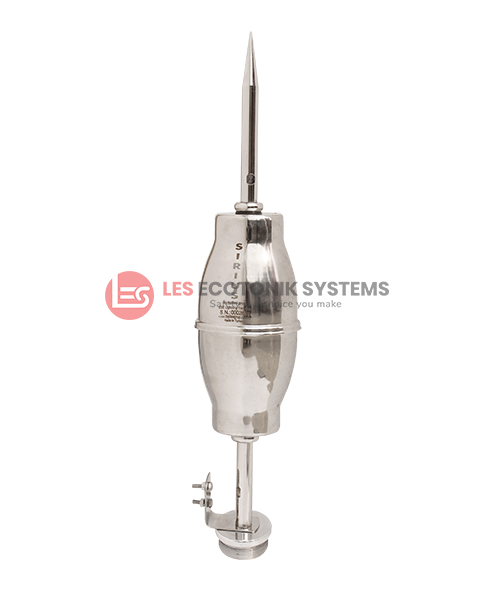
An ESE lightning arrester works differently. ESE stands for Early Streamer Emission. It actively emits an upward streamer when it detects an approaching lightning strike, intercepting the downward bolt from a greater distance and attracting it from a wider area.
Because of this active mechanism, an ESE arrester delivers a significantly larger protection radius than a conventional arrester at the same installation height. Protection radius for ESE systems is calculated per NF C 17-102 and UNE 21186 standards. In practical terms, an ESE arrester at 10 metres height with an advance time of 60 microseconds can protect a radius of 70 to 107 metres depending on the protection class selected.
This is why ESE arresters are the preferred choice for large industrial campuses, warehouses, stadiums, airports, telecom towers, and wide-span commercial structures where maximum area coverage from fewer units is essential.
Key Factors That Affect Protection Radius in Practice
Several real-world factors influence actual protection radius on the ground.
Installation height matters most. The higher the air terminal, the larger the protection cone. Even a small increase in height meaningfully expands coverage.
Protection class changes the radius too. Class I, which is the highest level for critical or high-risk structures, uses a tighter protection angle and smaller rolling sphere, giving a more precise but narrower zone. Class IV allows wider coverage but only for lower-risk applications.
Nearby obstructions such as tall trees, adjacent buildings, or elevated equipment can create shadow zones where the arrester coverage is reduced. The down conductor and earthing system quality also plays a major role. A protection radius calculation assumes the entire system, from air terminal to earth electrode, is correctly installed and working. A poor earthing system reduces effective protection even if the arrester itself is positioned perfectly.
Why Correct Protection Radius Planning Matters
In cities like Chennai, which faces heavy monsoon seasons and high lightning density, and in Pune, where industrial and IT infrastructure is expanding rapidly, getting the protection radius right is not optional. It is a safety necessity.
A building that is only partially covered because the protection radius was not correctly calculated is just as dangerous as a building with no protection at all. Coverage gaps are invisible but their consequences are not. This is why lightning protection system design must always be carried out by qualified engineers using proper risk assessment and standard-based calculations, not guesswork.
How LES Ecotonik Systems Gets the Protection Radius Right as a Trusted Lightning Arrester Manufacturer in Chennai
Calculating protection radius accurately requires both technical knowledge and real field experience. LES Ecotonik Systems, one of India’s most trusted names in lightning protection, brings both to every project. As a leading Lightning Arrester Manufacturer in Chennai, LES Ecotonik System conducts thorough site assessments, performs risk analysis as per IEC 62305, and designs protection layouts that ensure complete, gap-free, and standard-compliant coverage for every structure. Whether you need a single ESE arrester for a residential tower or a multi-point conventional system for an industrial campus, LES Ecotonik Systems delivers precision-engineered solutions with full documentation and post-installation support.
Choose Complete Coverage with LES Ecotonik Systems, Your Lightning Arrester Manufacturer in Pune
No building owner should have to guess whether their structure is fully protected. As a leading Lightning Arrester Manufacturer in Pune, LES Ecotonik Systems provides detailed protection radius drawings, compliance certificates, and professional installation services that give you complete confidence. With over three decades of experience, ISO 9001, 14001, and 45001 certification, and products tested by CPRI Government of India, LES Ecotonik Systems is the partner you need for protection that covers every corner. Visit www.leslightning.com or contact LES Ecotonik Systems today for a site-specific protection radius assessment and a complete lightning safety solution.
Conclusion
Protection radius is the foundation of any effective lightning protection system. Getting it right means understanding the arrester type, installation height, protection class, and calculation method. A conventional arrester protects a smaller height-dependent zone while an ESE arrester extends coverage across a much wider area from a single point. Both work well when correctly specified and installed. What matters most is that the system is designed by experts who calculate coverage accurately and leave no gaps. With a trusted Lightning Arrester Manufacturer in Chennai and Lightning Arrester Manufacturer in Pune like LES Ecotonik Systems by your side, you get not just a product but a complete protection solution backed by engineering expertise, certification, and a genuine commitment to your safety.