Published: September 7, 2026 | 8 Min Read
Why Do Buildings Get Struck by Lightning? Risks, Warning Signs & How to Protect Your Facility
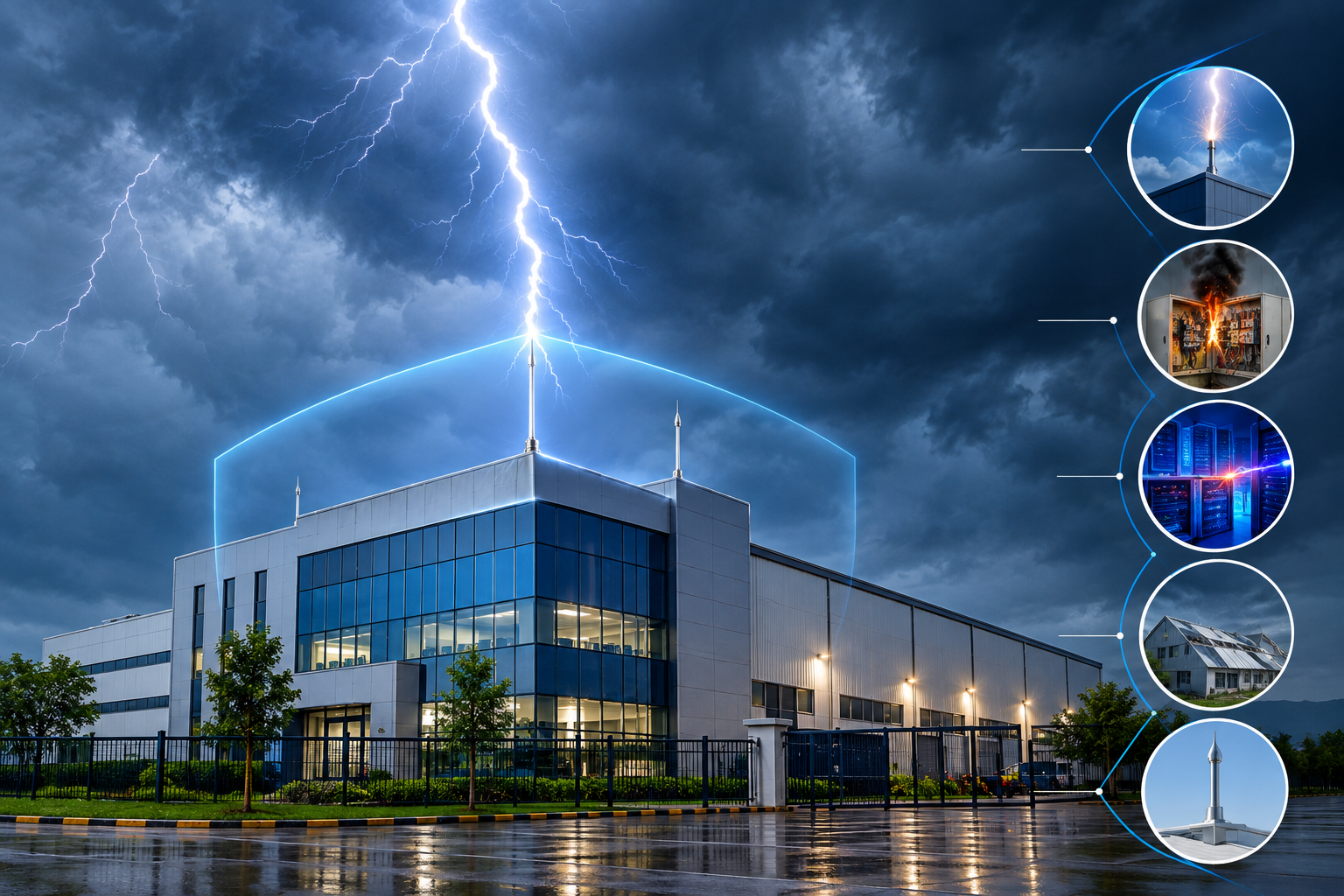
Every monsoon season, industrial units, IT parks, and commercial buildings across India report the same story: a sudden storm, a flash, and then a scramble to figure out what just got damaged.
If you’ve ever wondered why your building seems to be a magnet for lightning while the one next door never gets touched, the answer has less to do with bad luck and more to do with what’s installed on your roof.
What Makes a Structure a Lightning Target
Lightning takes the shortest, lowest-resistance path from the storm cloud to the ground.
A structure that stands taller than its surroundings, sits in an isolated or open area, or has exposed metal fittings on its roof effectively becomes that path.
This is why industrial sheds with large roof spans, telecom towers, and multi-building IT parks are frequently the ones reporting lightning-related damage; height and isolation are exactly the conditions lightning is drawn to.
What Happens When Lightning Strikes an Unprotected Building
The damage from an unprotected strike is rarely limited to the point of impact.
- Direct strike damage shows up as fire risk at the strike point, structural damage, and physical damage to roofing and rooftop equipment.
- Indirect damage is often the costlier surprise. A strike doesn’t need to hit your building directly to cause harm; the surge it generates can travel through power and data lines and damage electronics, control systems, and networking equipment inside the building.
- Human safety risk is the part that’s easiest to overlook. Without a properly designed and earthed protection system in place, people and equipment near the structure remain exposed during a strike event.
How a Lightning Protection System Works
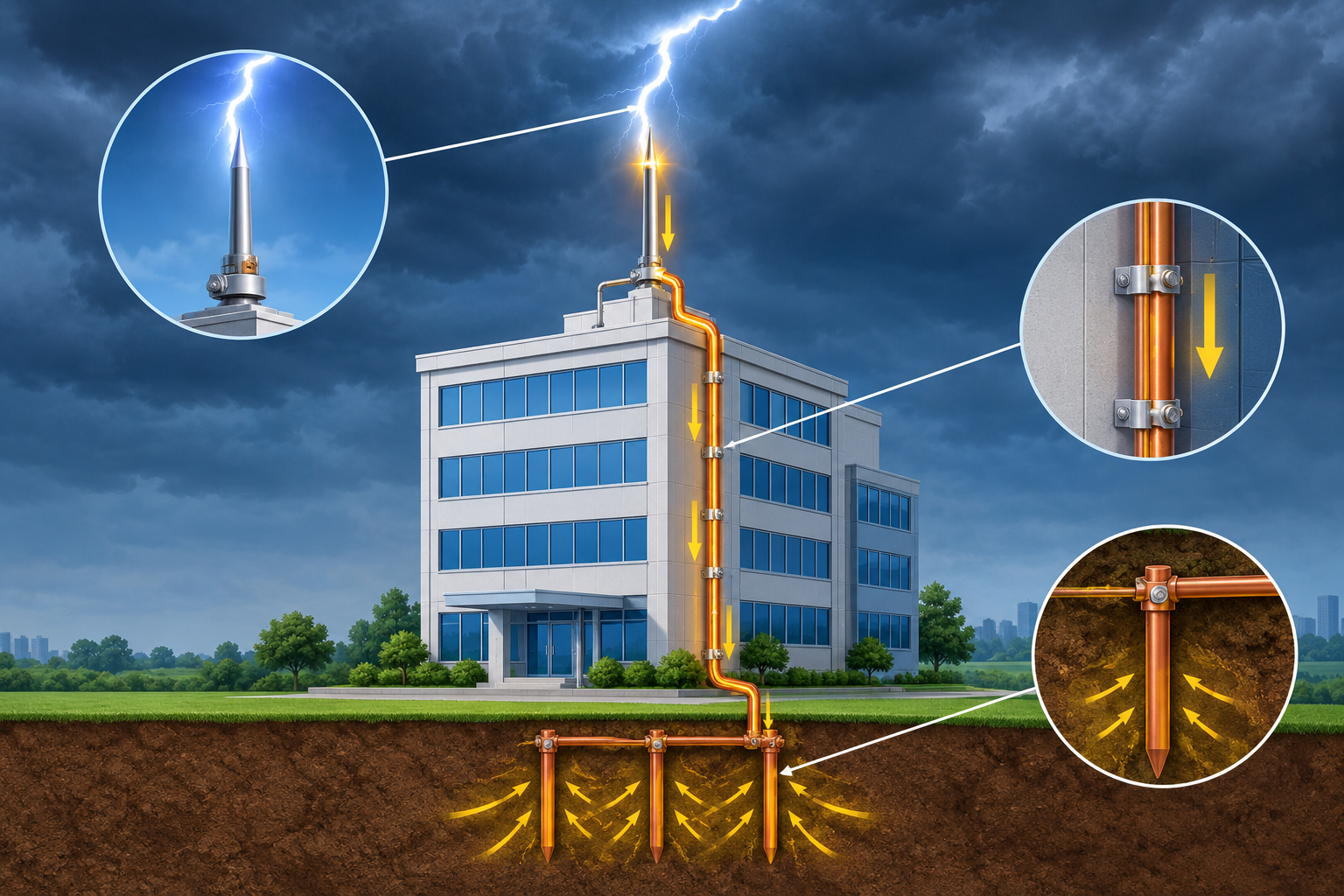
A properly designed lightning protection system is built to intercept a strike and guide it safely to the ground rather than letting it find an unpredictable path through your building or its wiring.
LES Ecotonik Systems has been active in this field since 2005, offering a range of external lightning protection devices designed around recognised standards including NF C 17-102 (2011 edition) and UNE 21186:2011, with products tested by CPRI (Government of India).
The range includes ESE (Early Streamer Emission) air terminals such as the SIRIUS, IONIA, UMBRAECO, and LYRA terminals, along with lightning strike recorders and flash counters (STORMFLASH 15, STORMFLASH 60, and the STRIKERX lightning strike counter) that let you track and verify how your system is performing over time.
Warning Signs Your Facility May Be Under-Protected
If you’re not sure where your building stands, these are worth checking:
- No visible air terminals on the highest points of your roofline or elevated rooftop equipment.
- No lightning strike recorder or flash counter installed; without one, you have no record of whether your system has actually intercepted a strike, or how many.
- Unexplained equipment failures during storms: repeated electronics issues that coincide with bad weather can point to surge exposure rather than routine equipment wear.
- No documentation on when the system was last inspected or serviced.
Why a Site Survey Matters
Every building is different; height, layout, roof construction, and surrounding structures all affect the level of risk and the right protection design.
That’s why LES Ecotonik’s approach starts with understanding your site rather than recommending a generic product.
With more than 30 years of combined experience in the lightning protection field, the team works through site assessment, product selection, installation, and ongoing technical support as one continuous process, not a one-time sale.
LES Ecotonik Systems is a “Make in India” organisation and an ISO 9001, ISO 14001 & ISO 45001 certified company, with a PAN-India presence supporting projects across Delhi, Noida, Gurgaon, Jaipur, Ahmedabad, Bhopal, Lucknow, Nagpur, Pune, Hyderabad, Bhubaneswar, Kolkata, Ernakulam, Bengaluru, Chennai, and Mumbai.
Frequently Asked Questions
Tall, isolated structures, or those with exposed metal roofing and fittings, offer lightning a shorter path to the ground, making them more likely to be strike points than the surrounding area.
A site assessment that looks at your building’s height, layout, roof construction, and surrounding structures is the starting point for determining what protection your facility needs. LES Ecotonik offers this as part of its site survey process.
The external lightning protection range includes ESE air terminals (SIRIUS, IONIA, UMBRAECO, LYRA), lightning strike recorders (STORMFLASH 15, STORMFLASH 60), and lightning flash/strike counters (STRIKERX), designed around NF C 17-102 (2011) and UNE 21186:2011, and CPRI-tested.
Next Steps: Get a Free Site Survey
Lightning risk isn’t something you can assess by eye. If your facility has never had a professional site survey, or if it’s been a while since the last one, the safest next step is to get it looked at before the next storm season.
Not sure if your facility is adequately protected?
Request a free on-site lightning risk survey from LES Ecotonik’s team.
Call +91 98869 63195 / +91 63619 84430 or email info@leslightning.com .