
Top 10 Benefits of Proper Earthing and Bonding for Industrial Facilities
Introduction
Current transformers and potential transformers form the backbone of accurate metering and reliable protection in any electrical network. These units are small in size but carry enormous responsibility, since every relay trip decision and every billing reading depends on the values they report. When installation goes wrong, the consequences are rarely visible right away. They surface weeks or months later as nuisance tripping, inaccurate bills, or a protection system that fails silently during a real fault. As an experienced CT PT Transformer Manufacturer, LES Ecotonik Systems has worked with panel builders, electrical contractors, and substation teams across India, and the same handful of installation errors keep showing up on site visits.
What Earthing and Bonding Actually Do
Why Installation Quality Cannot Be an Afterthought
A CT or PT is only as good as the way it is wired, mounted, and earthed. Getting it right the first time saves site teams from repeated call backs, failed audits, and costly downtime later.
Mistake 1: Mixing Up Polarity Markings
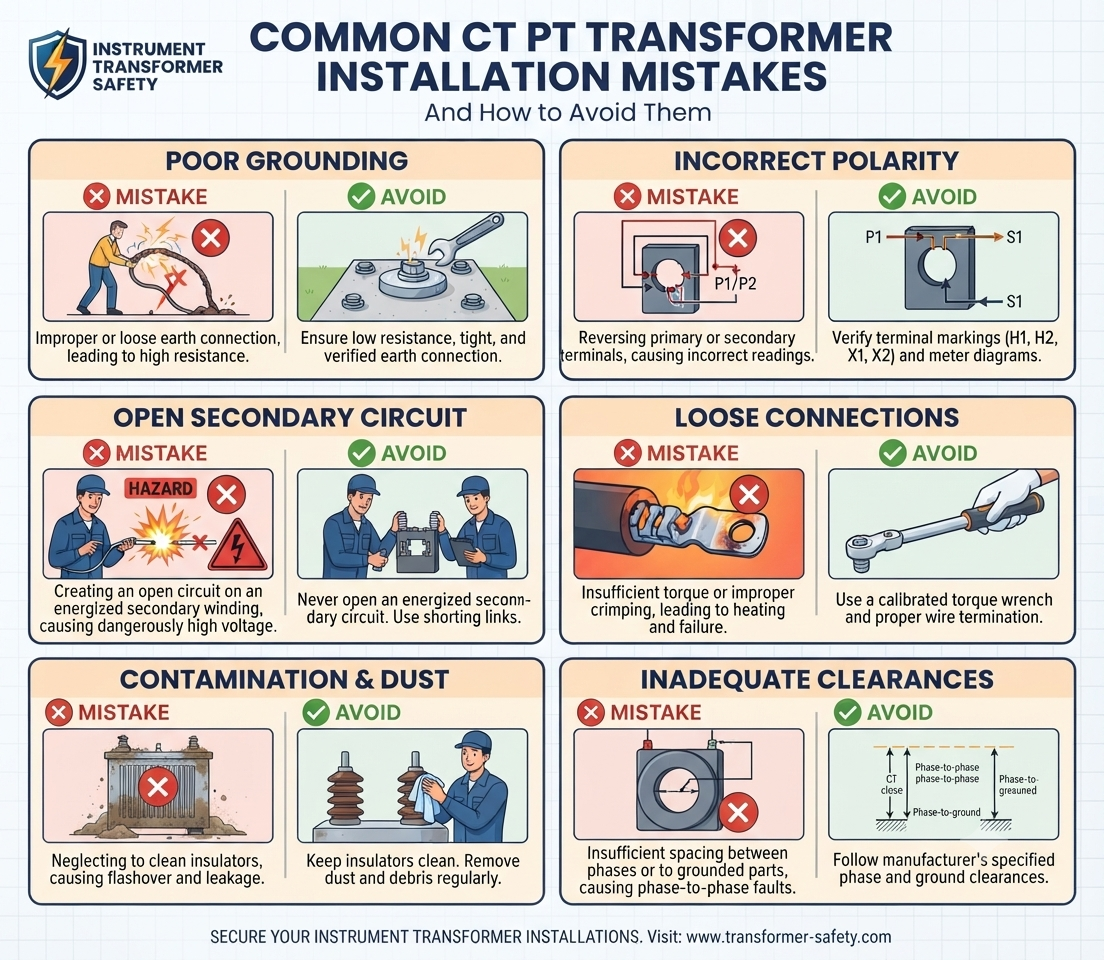
Every CT and PT has clearly marked polarity terminals, usually labeled P1, P2, S1, and S2. When these are connected in the wrong sequence, protection relays receive a distorted picture of current direction. During an actual fault, this can mean the relay looks the other way instead of tripping, or it trips when nothing is wrong.
- Double check polarity marks against the manufacturer nameplate before wiring
- Use a dedicated polarity tester before the system is energized
- Never assume terminal position based on habit from a different transformer brand
Mistake 2: Energizing a CT With Its Secondary Left Open
This is one of the most dangerous mistakes on any site. A current transformer is designed to always have a closed secondary loop. If the secondary circuit is opened while the primary is still carrying current, the CT can generate voltage high enough to injure a technician or damage the insulation permanently.
- Always place a shorting link across the secondary terminals before disconnecting any meter or relay
- Keep dedicated shorting blocks on hand at every panel where CTs are installed
- Brief every technician on this rule before they are allowed to touch CT wiring
Mistake 3: Weak or Missing Earthing on the Transformer Body
CT and PT bodies must be earthed independently from their secondary circuit earth point. Skipping this step, or bonding it incorrectly, creates two problems at once. It leaves a shock hazard on the metal casing, and it introduces measurement drift because the reference potential is no longer stable.
- Provide a separate, dedicated earth connection for the transformer body
- Confirm a single earthing reference point is used to avoid circulating currents between multiple grounds
- Verify earth continuity with a proper test before the panel is commissioned
Mistake 4: Picking the Wrong Ratio or Accuracy Class
A transformer selected without matching the actual load profile leads to two very different but equally costly outcomes. An undersized ratio saturates during fault conditions and blinds the protection scheme exactly when it is needed most. An oversized ratio gives poor resolution at normal load, which shows up as inaccurate billing over time.
- Study the expected load current and fault current before finalizing the ratio
- Match the accuracy class to the actual use case, since metering and protection have different requirements
- Involve your CT PT Transformer Manufacturer at the design stage instead of after procurement is already finalized
Mistake 5: Careless Mounting and Ignoring Vibration
Transformers installed near large motors, compressors, or heavy switchgear experience continuous low level vibration. Over months, this loosens terminal screws and mounting brackets, creating intermittent faults that are notoriously hard to trace back to their source.
- Follow the mounting orientation and torque values specified by the manufacturer
- Add vibration dampening supports in areas close to rotating machinery
- Schedule a physical check of mounting hardware during every routine maintenance visit
Mistake 6: Rushing Through or Skipping Commissioning Tests
Under project deadline pressure, some teams treat commissioning tests as optional paperwork rather than a genuine verification step. This is where hidden wiring errors and insulation weaknesses should be caught, before the system goes live and a fault exposes them the hard way.
- Run ratio tests, polarity checks, and insulation resistance tests as a mandatory step, not an optional one
- Keep signed test records on file for every unit installed
- Repeat key tests periodically as part of an ongoing maintenance calendar
Mistake 7: Overloading the Secondary Circuit Beyond Its Burden Rating
Every CT is rated for a maximum burden, meaning the total load its secondary circuit can safely support without accuracy loss. Connecting too many meters and relays to one CT, or running excessively long secondary cables, quietly pushes the burden past its design limit.
- Calculate the total connected burden, including the resistance added by long cable runs
- Select a CT with burden capacity that comfortably covers the intended application
- Keep secondary wiring as short and direct as the installation allows
How LES Ecotonik Systems Supports Correct Installation
LES Ecotonik Systems does not stop at delivering a transformer to site. As a trusted CT PT Transformer Manufacturer, our technical team works alongside panel builders and electrical contractors to review wiring diagrams, confirm ratio and burden selection, and guide commissioning tests so that every installation performs exactly as designed from day one.
Conclusion
Most CT and PT related failures in the field are not caused by faulty equipment. They come from small installation shortcuts that seemed harmless at the time. Reversed polarity, an open secondary, weak earthing, a mismatched ratio, loose mounting, skipped tests, and an overloaded burden are all avoidable with a careful, disciplined installation process. As a dependable CT PT Transformer Manufacturer, LES Ecotonik Systems is ready to guide your team through selection, installation, and testing so your metering and protection systems stay accurate and safe for years to come.