How to Choose the Right Lightning Arrester for High-Rise Buildings in Mumbai
Mumbai is one of India’s most dynamic cities. It is home to towering residential skyscrapers, iconic commercial towers, five-star hotels, sprawling IT parks, and critical infrastructure that runs around the clock. With the Arabian Sea on one side and a tropical monsoon climate dominating nearly half the year, Mumbai also experiences some of the most intense thunderstorm activity in the country. For high-rise buildings in this city, the risk of a direct lightning strike or an indirect surge is not theoretical. It is a real, recurring threat that demands serious engineering attention.
Choosing the right lightning arrester for a high-rise building in Mumbai is not as simple as picking any device off a catalogue. It requires understanding the building’s height, structure, occupancy type, electrical load, and the level of protection required under Indian and international standards. This guide walks you through exactly what to consider before making that decision.
Understanding Why High-Rise Buildings Face Greater Lightning Risk
Height is the primary factor that determines lightning vulnerability. The taller a structure is, the more likely it is to intercept a lightning discharge. In Mumbai, buildings above 45 metres are already classified as high-rise under local regulations, and many towers in areas like Worli, Bandra Kurla Complex, Nariman Point, and Powai exceed 100 to 200 metres.
At these heights, a building does not just receive downward lightning strokes. It can also trigger upward lightning, which originates from the structure itself and travels toward charged storm clouds. Upward lightning is far more common in very tall buildings and carries enormous energy that standard low-grade arresters cannot handle.
Additionally, high-rise buildings in Mumbai house sensitive systems including centralised air conditioning, elevators, fire alarm networks, data servers, CCTV systems, and emergency power backups. A single lightning event, even without a direct strike, can send a surge through the electrical network and damage all of these systems simultaneously.
Key Factors to Consider When Choosing a Lightning Arrester
Selecting the right lightning arrester for a Mumbai high-rise involves evaluating several technical and site-specific parameters.
Building Height and Structural Profile
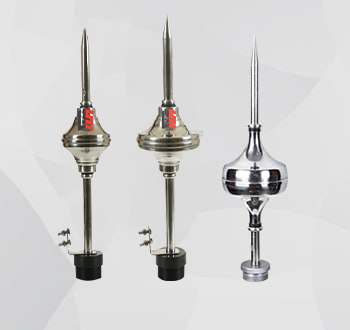
The height and shape of the building determine the protection radius needed. Taller and irregularly shaped structures need arresters with wider protection zones. Early Streamer Emission arresters, commonly known as ESE arresters, are widely used for high-rise applications because they offer a larger protection radius compared to conventional Franklin rod systems.
Risk Assessment as per IEC 62305
Before any arrester is selected, a formal lightning risk assessment must be conducted as per IEC 62305, which is the international standard for lightning protection. This assessment calculates the annual probability of a lightning strike based on the building’s location, height, occupancy, and the average ground flash density of the region. Mumbai has a high ground flash density due to its coastal tropical climate, which means the risk level is typically higher than in many other Indian cities.
The outcome of this assessment determines the Lightning Protection Level required, ranging from LPL I to LPL IV, where LPL I offers the highest degree of protection. Most high-rise buildings with critical occupancy in Mumbai fall under LPL I or LPL II categories.
Type of Arrester Technology
There are two primary technologies used in high-rise lightning protection:
Conventional lightning protection systems use a network of air terminals, down conductors, and earth termination systems to intercept and safely conduct lightning to the ground. They are reliable, widely proven, and fully compliant with IEC 62305.
ESE lightning arresters use an active triggering mechanism that emits an upward leader earlier than a conventional rod, extending the protection zone significantly. They are particularly effective for large rooftop areas, terraces, and open structures atop high-rise buildings.
For most Mumbai high-rises, a combination of both approaches delivers the most comprehensive protection, especially when the building has rooftop mechanical equipment, antennas, or helipads.
Surge Protection Integration
A lightning arrester protects the structure from a direct strike, but it does not by itself protect internal electrical and electronic systems from induced surges. High-rise buildings must also install Surge Protection Devices at the main distribution board, sub-distribution boards, and at the point of use for sensitive equipment. This layered protection approach ensures that the energy from a lightning event does not enter and damage the building’s internal systems even if the structural protection is functioning correctly.
Material Quality and Certification
The quality of the materials used in lightning protection systems directly impacts how long and how effectively the system performs. Copper and aluminium are the preferred conductor materials. Stainless steel and copper-bonded rods are used for earth electrodes. All components must carry relevant certifications and comply with IS 2309, IEC 62305, and NFC 17-102 standards where applicable.
Buildings in Mumbai’s coastal zones face additional challenges from salt-laden air and high humidity, which accelerate corrosion. It is critical to select arresters and conductors that are rated for coastal and high-humidity environments.
Maintenance and Inspection Planning
A lightning protection system is not a one-time installation. It requires periodic inspection, especially after major thunderstorm seasons. High-rise buildings in Mumbai should schedule annual inspections that include checking the condition of air terminals, verifying the integrity of down conductors, measuring earth resistance, and testing SPD functionality. Any system that cannot be inspected and maintained over time is a liability, not a safety measure.
Why LES Ecotonik Systems Is the Trusted Choice Among Lightning Arrester Manufacturers in Mumbai
When it comes to protecting high-rise buildings in Mumbai, LES Ecotonik Systems stands among the most experienced and trusted Lightning Arrester Manufacturers in Mumbai. With ISO 9001, 14001, and 45001 certifications and over three decades of field experience, LES Ecotonik Systems brings technical depth and product reliability that building developers, EPC contractors, and facility managers rely on.
Every solution offered by LES Ecotonik Systems is engineered after a thorough site assessment, ensuring that the arrester type, protection level, conductor sizing, and earthing design are all matched precisely to the building’s profile and occupancy requirements.
What Makes LES Ecotonik Systems the Right Partner as a Lightning Arrester Manufacturer in Mumbai
LES Ecotonik System offers a complete range of lightning protection products including ESE arresters, conventional air terminal systems, aluminium conductor systems, surge protection devices, and earthing solutions, all tested and certified to international standards.
Their engineering team works directly with architects, structural consultants, and MEP contractors during the design phase, ensuring that the lightning protection system is integrated correctly from the construction stage rather than added as an afterthought. This approach significantly reduces installation costs and improves the long-term reliability of the protection system.
For Mumbai’s high-rise developers, facility managers, and safety consultants, partnering with LES Ecotonik Systems as a dedicated Lightning Arrester Manufacturer in Mumbai means access to IEC-compliant products, qualified installation support, and dependable after-sales service throughout the building’s lifecycle.
Conclusion
Mumbai’s skyline continues to grow taller, and so does the responsibility of protecting the people and infrastructure within these structures. Choosing the right lightning arrester for a high-rise building is a technical decision that must account for building height, risk level, arrester technology, surge protection integration, material quality, and long-term maintenance.
LES Ecotonik Systems, a leading Lightning Arrester Manufacturer in Mumbai provides the engineering expertise, certified products, and complete protection solutions that Mumbai’s high-rise buildings demand. When it comes to lightning safety, there is no room for compromise, and LES Ecotonik Systems ensures you never have to make one.