Introduction
Every building that stands above the ground carries a risk during a thunderstorm. Lightning does not discriminate between a small office block and a large industrial facility. What matters is height, exposure, and the presence of conductive materials. The real question for every building owner, architect, or facility manager is not whether to install lightning protection but which type of system to install.
Two technologies dominate the lightning protection market today. The first is the conventional lightning arrester, which has been used for centuries. The second is the ESE lightning arrester, a more advanced system that has gained wide adoption across commercial and industrial projects globally. Both protect buildings from direct lightning strikes. But they work differently, cover different areas, and suit different types of structures. This blog explains both clearly so you can make an informed decision for your building.
What Is a Conventional Lightning Arrester?
A conventional lightning arrester, also known as a Franklin rod or spike arrester, is a passive protection device. It is a pointed metal rod, typically made of copper or aluminium, installed at the highest point of a structure. It does not actively attract lightning. Instead, it provides a preferred low-resistance termination point for a lightning strike that is already descending toward the structure.
When lightning approaches, the conventional rod intercepts the downward leader and channels the massive electrical current safely through the down conductors into the earthing system buried in the ground. The energy is then safely dispersed into the earth without damaging the structure or its contents.
Conventional arresters are straightforward, durable, and cost-effective. They have no moving parts, require no power supply, and need very little maintenance. However, the protection zone they cover is directly determined by their installation height. A taller rod protects a wider area, but for large or complex structures, multiple rods and an interconnected network of conductors are needed to achieve complete coverage.
What Is an ESE Lightning Arrester?
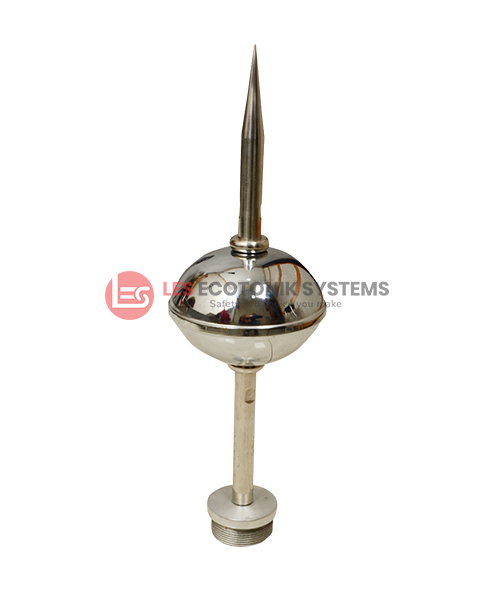
ESE stands for Early Streamer Emission. An ESE lightning arrester is an active device that goes a step beyond passive protection. When storm conditions develop and the atmospheric electric field starts building up, the ESE arrester internally generates and emits an upward ionised streamer ahead of time. This upward streamer travels toward the descending lightning leader faster than natural streamers would form from the same point.
The result is that the ESE arrester intercepts the lightning strike from a greater horizontal distance than a conventional rod of the same height. This early interception creates a significantly wider cone of protection around the arrester, which is called the protection radius.
ESE arresters are designed and tested under international standards including NF C 17-102 and UNE 21186. The protection radius is calculated based on the installation height and the advance time of the arrester, which is a measured parameter that indicates how much earlier the ESE device emits its streamer compared to a natural rod. A higher advance time means a wider protection radius.
For example, an ESE arrester with an advance time of 60 microseconds installed at a height of 10 metres above a structure can protect a radius of 70 to 107 metres depending on the class of protection required. A conventional rod at the same height would protect a much smaller zone of 10 to 30 metres.
Key Differences Between ESE and Conventional Lightning Arresters
The most important difference is the protection radius. An ESE arrester covers a much larger area from a single installation point compared to a conventional rod. For wide structures, large rooftops, open industrial yards, or multi-building campuses, this means fewer units are needed to achieve complete protection.
The second difference is the mechanism. A conventional arrester is completely passive. It waits for a strike to come to it. An ESE arrester actively prepares and reaches out toward the approaching strike, intercepting it earlier and from further away.
The third difference is the applicable standard. Conventional systems follow IEC 62305, which uses the rolling sphere method and protection angle method for layout design. ESE systems follow NF C 17-102 or UNE 21186, which define the advance time measurement and protection radius calculation method specific to early streamer devices.
The fourth difference is cost. Conventional systems using multiple rods, mesh conductors, and extensive down conductor networks can be more expensive to install for large structures. A single well-placed ESE arrester covering the same area may offer a more cost-effective solution when the full system cost is calculated.
Which Type of Structure Needs Which System?
The right choice depends on the size, shape, and use of your building.
Conventional lightning arresters work best for smaller residential buildings, compact commercial structures, low-rise buildings, or locations where a mesh system of multiple rods can be practically laid out across the rooftop. They are also the preferred choice where a distributed network of protection points is more practical than a single central unit.
ESE lightning arresters are the better choice for large industrial plants, warehouses, factory sheds, open storage yards, telecom towers, rooftop equipment platforms, stadiums, airports, fuel storage facilities, and any structure where achieving complete coverage from fewer installation points is both technically and economically preferable. For heritage structures or buildings where visible rooftop installations must be minimised, a single ESE unit is far less intrusive than a full mesh system.
For high-rise buildings, both systems can be used depending on the risk assessment and protection class required. The decision should always be made by a qualified lightning protection engineer who conducts a site-specific risk assessment as per IEC 62305 before recommending a system.
Common Mistakes When Choosing Between ESE and Conventional Systems
Many building owners make the mistake of choosing based on cost alone. Picking the cheapest option without a proper risk assessment often results in incomplete protection, compliance failures, and expensive retrofits later.
Another common mistake is assuming that one conventional rod is sufficient for a large building. A single Franklin rod protects only the area within its limited cone. For a 40-metre wide factory shed, one rod at the ridge will leave large portions of the building unprotected.
Similarly, some buyers assume that any ESE device will cover their entire facility regardless of its specifications. Every ESE arrester has its own coverage zone, shaped by three factors working together: how early it emits its streamer, how high it is mounted, and what level of protection the building demands. These must be calculated correctly for each specific project.
Always insist on protection layout drawings from your supplier that show the calculated protection zones overlaid on your building plan. This is the only way to confirm that your system provides complete, gap-free coverage.
Why LES Lightning Is the Trusted Name for Both Systems as a Leading Lightning Arrester Manufacturer in Chennai
Whether your project calls for a conventional system, an ESE system, or a combination of both, working with a manufacturer who understands both technologies in depth is essential. LES Lightning, operating as LES Ecotonik System, is one of India’s most experienced names in complete lightning protection solutions. As a trusted Lightning Arrester Manufacturer in Chennai, LES Lightning supplies both conventional lightning rods and CPRI tested ESE lightning arresters that comply with IEC 62305, NF C 17-102, and UNE 21186 standards. Every project is supported by a detailed risk assessment, protection layout design, and full documentation so your system is compliant, complete, and audit-ready from day one.
Get the Right System for Your Building from LES Lightning, Your Lightning Arrester Manufacturer in Chennai
Choosing between ESE and conventional lightning arresters is a technical decision that must be based on your specific building dimensions, risk level, and protection class requirements. LES Lightning makes this process straightforward. As a leading Lightning Arrester Manufacturer in Chennai, LES Lightning provides pre-project consultation, site-specific protection radius calculations, product supply, installation support, and post-installation testing across Chennai and all major cities in India. With ISO 9001, 14001, and 45001 certification and over three decades of field experience, LES Lightning is the partner you can rely on when safety is non-negotiable. Visit www.leslightning.com today to request a site assessment and find out exactly which system your building needs.
Conclusion
ESE and conventional lightning arresters are both proven technologies, but they are not interchangeable. A conventional rod is passive, reliable, and ideal for smaller or simpler structures. An ESE arrester is active, covers a wider area, and is the preferred choice for large industrial and commercial buildings where complete coverage from fewer units is needed. The right choice is always based on a proper risk assessment, correct protection class selection, and compliance with applicable international standards. Never choose a system based on price alone or without professional engineering support. With a reliable Lightning Arrester Manufacturer in Chennai like LES Lightning guiding your project from assessment to installation, you can be confident that your building is protected correctly, completely, and in full compliance with the standards that matter.
LES Lightning | LES Ecotonik Systems | Lightning Arrester Manufacturer in Chennai | www.leslightning.com