
Introduction
A lightning strike lasts less than a second. But the damage it leaves behind can take months to repair and cost lakhs of rupees. For industrial plants, warehouses, commercial buildings, and IT facilities, the risk is not just financial. It is operational, safety-related, and in some cases irreversible.
Installing a lightning arrester is one of the most important protective steps any building owner or facility manager can take. But installation is not simply about fixing a rod on a rooftop. A proper lightning arrester installation follows a defined process, covers every component of the system, and must comply with international standards like IEC 62305. This step by step guide walks you through the complete installation process in plain, practical language.
Step 1: Conduct a Site Risk Assessment
Before any product is purchased or any work begins, a thorough site risk assessment must be completed. This assessment evaluates the lightning threat level for your specific location based on factors like the local ground flash density, the size and height of the structure, the type of activities carried out inside, and the value of equipment and human life at risk.
The risk assessment determines the Lightning Protection Level required for your building. There are four levels ranging from LPL I for the highest risk structures like hospitals and data centres to LPL IV for lower risk buildings. The protection level directly decides what type of arrester you need, how many, and where they must be placed.
Skipping the risk assessment is the most common and most costly mistake made in lightning protection projects. Without it, the system may be undersized, incorrectly positioned, or simply not compliant with safety standards.
Step 2: Select the Right Type of Lightning Arrester
Once the risk level is determined, the next step is selecting the correct arrester type. There are two main categories used in industrial and commercial installations.
A conventional lightning arrester, also known as a Franklin rod or spike arrester, is a passive device mounted at the highest point of the structure. It provides a preferred strike point and channels the current safely to earth. It works best for smaller structures or as part of a multi-rod system for larger footprints.
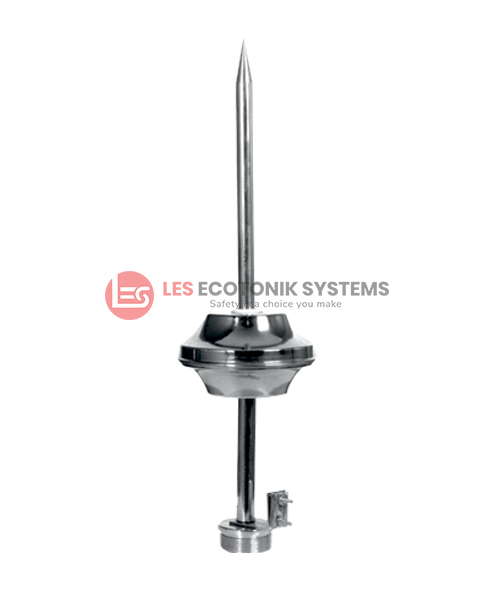
An ESE lightning arrester, which stands for Early Streamer Emission, actively emits an upward leader during a thunderstorm to intercept the lightning at a greater distance. This gives it a significantly wider protection radius and makes it the preferred choice for large industrial sites, open yards, telecom towers, stadiums, and multi-building campuses.
Your selection must match the protection level identified in the risk assessment and must comply with applicable standards such as IEC 62305 for conventional systems or NF C 17-102 for ESE systems.
Step 3: Design the Air Termination System
The air termination system is the part of the installation that intercepts the lightning strike. It includes the lightning arrester itself along with any additional rods, mesh conductors, or catenary wires placed on the rooftop or elevated surfaces.
The positioning of the air terminal must be calculated using the rolling sphere method, the protective angle method, or the mesh method depending on the shape and complexity of the structure. The goal is to ensure that every vulnerable part of the roof and structure falls within the calculated protection zone of the installed arrester.
For flat industrial rooftops, mesh conductors are often used alongside a central ESE rod to achieve full coverage. For structures with equipment like HVAC units, cooling towers, or antenna masts on the roof, each elevated element must be checked against the protection radius to confirm it is shielded.
Step 4: Install the Down Conductors
Down conductors are the cables that carry the lightning current from the air terminal at the top of the building safely down to the earthing system at ground level. They must be made of materials with high conductivity and low resistance, typically copper or aluminium, and must be sized to handle the high current of a direct strike without overheating or melting.
The number of down conductors required depends on the size of the building and the protection level. Larger buildings need multiple down conductors spaced evenly around the perimeter to distribute the lightning current and reduce the magnetic field effects inside the structure.
Down conductors must be routed as straight and vertical as possible, avoiding sharp bends that increase impedance. They must be securely fixed to the outer wall of the building at regular intervals using approved clamps and brackets. Where conductors pass through or near metallic structures, proper separation distances must be maintained to prevent side flashing.
Step 5: Install the Earthing System
The earthing system serves as the final destination where lightning current is safely absorbed and neutralized into the ground. No matter how well designed the rest of the system is, it will not function properly without a reliable, low-resistance earthing setup.
Earth electrodes, typically copper bonded rods, are driven into the ground at the base of each down conductor. In areas where soil resistivity is high, such as rocky terrain or sandy soil, chemical earthing compounds or multiple interconnected rods are used to bring the earth resistance down to the required level, generally below 10 ohms and ideally below 1 ohm for critical installations.
All earth electrodes must be interconnected through a ring earth conductor that runs around the base of the building. This ring equalises the potential across all electrodes and significantly improves the performance of the overall system.
Step 6: Install Equipotential Bonding and Surge Protection
A complete lightning protection installation does not stop at the air terminal and earth electrode. Internal protection is equally important. Equipotential bonding connects all metal services entering the building, including water pipes, gas pipes, data cables, and power lines, to the earthing system. This ensures there is no dangerous voltage difference between any two points inside the building when lightning current flows through the system.
Surge Protection Devices must be installed at the main electrical panel, sub-panels, and at sensitive equipment terminals to protect against conducted surges that travel through power and data lines during a nearby or direct lightning event. Without SPDs, even a well-earthed system can allow damaging transient voltages to reach critical equipment.
Step 7: Test, Inspect and Document
After installation is complete, every part of the system must be tested and documented before the building is considered protected. Earth resistance testing must confirm that resistance values meet the required standard. Visual inspections must verify that all connections are secure, all conductors are properly routed, and all components are installed as per the design drawings.
A full set of as-built drawings, test reports, and compliance certificates must be prepared and kept on file. These documents are required for regulatory inspections, insurance purposes, and future maintenance visits.
The system must be re-inspected at regular intervals, typically every one to two years, to check for corrosion, mechanical damage, or changes in earth resistance over time.
Why LES Ecotonik Systems Is the Right Partner for Your Installation as a Trusted Lightning Arrester Manufacturer in Hyderabad
A step by step process is only as good as the team and products behind it. LES Ecotonik System brings over three decades of experience in designing and supplying complete lightning protection systems for industrial and commercial buildings across India. As a leading Lightning Arrester Manufacturer in Hyderabad, LES Ecotonik Systems provides ESE arresters, conventional rods, down conductors, earth electrodes, bonding hardware, and surge protection devices that fully comply with IEC 62305, NF C 17-102, and CPRI tested standards. Every product leaves the facility with complete test documentation so your installation is audit-ready from day one.
Plan Your Installation with LES Ecotonik Systems, Your Reliable Lightning Arrester Manufacturer in Jaipur
Whether you are protecting a new industrial facility, upgrading an existing system, or designing lightning protection for a large commercial complex, LES Ecotonik Systems is equipped to support your project from risk assessment to final testing. As a trusted Lightning Arrester Manufacturer in Jaipur, LES Ecotonik Systems offers pre-bid consultation, protection layout design, product supply, and post-installation technical support across every stage of the project. With ISO 9001, 14001, and 45001 certification and a nationwide service presence, LES Ecotonik Systems is the one partner you need for lightning protection that is correctly installed, fully compliant, and genuinely effective. Visit www.leslightning.com today to get started.
Conclusion
Installing a lightning arrester correctly is a multi-step process that goes far beyond placing a rod on a rooftop. It begins with a proper risk assessment, moves through careful design of the air termination, down conductors, and earthing system, and ends with full testing and documentation. Every step matters. Missing even one can leave your building exposed to the full force of a direct strike. For industrial and commercial buildings in India where the cost of downtime, equipment loss, and fire damage is high, a properly installed lightning protection system is one of the most valuable safety investments you can make. With a proven Lightning Arrester Manufacturer in Hyderabad and Lightning Arrester Manufacturer in Jaipur like LES Ecotonik Systems guiding your project, you can be confident that every step is done right.